
How Early Maintenance Planning Can Save Thousands Before Peak Season
Why Q1 decisions determine uptime, budgets, and guest experience all season long
Key Takeaways
● Plan early, avoid emergencies: Q1 maintenance prevents expensive spring breakdowns.● Downtime costs revenue: Emergency repairs during peak season mean higher costs and missed programming.● Equipment age matters: Older systems fail under full load, assess the condition before ramping up.● Scheduled maintenance smooths budgets: Predictable monthly costs beat unpredictable emergency spending.● Confidence matters: Entering peak season with known system performance reduces stress for staff and leadership.
Facility operators know the pattern. When usage ramps up, systems that have been running at reduced capacity get pushed back to full performance. That’s often when pump motors fail, filtration performance drops, or controls don’t respond as expected. What should be a smooth transition into the busy season turns into emergency calls and unplanned commercial pool maintenance, which can accumulate into the thousands.
For many operators, the transition into peak season is less about excitement and more about uncertainty.
Why Q1 is the Ideal Maintenance Window
January through March gives operators breathing room. Facilities are often running below peak demand, technician availability is higher, and parts are easier to source. Winter often offers the maintenance window the busy season doesn’t permit, creating space for thorough inspections, system testing, and targeted repairs before swim lessons, lap swimmers, and community programs are back at full capacity.
By April and May, that flexibility disappears. Service calendars fill quickly, and lead times extend, making even routine repairs harder to schedule.
The Real Cost of Reactive Repair
When equipment fails during the busy season, commercial pool maintenance costs escalate quickly. Emergency service typically carries higher labor rates and programming has to pause while systems are repaired. Staff time shifts from running the facility to coordinating fixes.
A pump motor replacement that could be handled during the winter at a predictable cost often becomes significantly more expensive once it turns into an emergency in May. For destination resorts, hotels, water parks with high summer traffic, and community pools with packed seasonal program schedules, the ripple effects reach well beyond the maintenance budget.
Common Spring Failures Operators Face
After months of reduced operation, certain issues surface consistently. Pump motors and seals often develop bearing noise or leaks once restarted, and filter media, grids, or cartridges may struggle under full flow.
On the chemical and controls side, controllers, and sensors drift out of calibration during downtime. Heaters can reveal scaling or burner problems under sustained load, and valves and automation components are prone to failure when regular cycling resumes. These issues are familiar to experienced operators, which is exactly why early assessment matters.
How Landmark Supports Preventive Planning
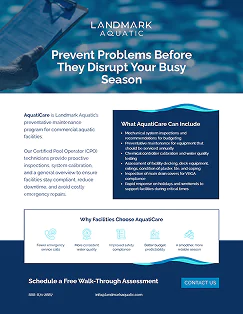
Landmark’s AquatiCare Service Plans are built on a simple principle: planned maintenance costs less and systems perform better than reactive service.
Our factory-trained, Certified Pool Operator (CPO) technicians assess system conditions with an Annual HealthCheckTM performed during the Q1 maintenance window and help operators forecast upcoming needs based on equipment age and historical performance. Work is scheduled strategically to keep operations running smoothly, and common components are stocked to avoid emergency shipping costs.
Because every facility is different, AquatiCare programs are fully customizable, with maintenance visits scheduled to align with your operational calendar. Participants benefit from proactive commercial pool care and priority response when unexpected issues arise, along with clearer visibility into long-term maintenance planning.
Planning Pays
A few hours of assessment in January can prevent days of downtime in May. In many cases, the cost savings from avoiding just one emergency repair offsets much of a year’s preventive maintenance investment.
Early maintenance planning is about doing the right work at the right time.
If you’re heading into peak season, now is the time to understand what your systems are telling you. Talk through your pre-season priorities with an aquatic systems specialist today.